The woman at the center of a well known Hollywood family
When I look at the story of Elsa Fabares, I see a life that was never built around fame, yet it touched fame at every turn. She was better known as Elsa Rose Eyler Fabares, born in 1911 in Manila, Philippines, and her name now survives most clearly through her family, especially her daughter Shelley Fabares, the actress and singer who became a household name. Elsa did not leave behind a public career full of headlines or movie posters. Instead, she left something more intimate and enduring: a family line tied to American entertainment history, a home life that shaped two daughters, and a personal story marked by love, illness, and memory.
I think of Elsa as a figure standing just outside the spotlight, close enough to feel its heat but never trying to step into it. That position can hide a person’s depth, but it can also reveal it. In Elsa’s case, the trail of dates, relationships, and family details shows a woman whose life was threaded tightly into the lives of others.
Early life and family roots
Samuel Hamilton Eyler and Ethel May Rumsey had Elsa. Family documents identify her father as a shipping agent, which places her birth in a mobile, multinational setting rather than a tranquil local village. Manila had trade, travel, and colonial crossings in 1911. That beginning expands Elsa’s story more than most understand.
The family tree begins with her parents. Ethel May Rumsey carried the Rumsey family name, while Samuel Hamilton Eyler brought the Eyler name. They left Elsa the basis of a family that would marry and have children in American show industry. Family stories are like underground rivers, therefore roots matter. Though concealed for years, they shape everything above them.
Elsa kept discreet, although her early childhood implies a cross-cultural life. By the time she was an adult, she was part of an American household in Los Angeles, which would influence her daughters.
Marriage to James Alan Fabares
On March 8, 1931, Elsa married James Alan Fabares in Los Angeles. This marriage is the central bridge between her own life and the better known public life that followed. James was connected with real estate, which suggests a family world grounded less in performance and more in practical work, property, and stability.
Their marriage appears to have been a long one. Together, they raised two daughters and built a family identity that later became closely associated with Hollywood, even if Elsa herself never became a public performer. I see this as one of the most important parts of her story. Many lives are remembered because of what they produce, and in Elsa’s case the most visible result was a family that produced talent, public attention, and eventually cultural memory.
James Alan Fabares remains important because he was not simply a spouse in the background. He was part of the household that shaped Shelley and Nanette, part of the domestic structure around which Elsa’s life moved. Family biographies often flatten spouses into footnotes. In Elsa’s case, James belongs fully in the frame because the household was built by both of them.
The children who carried the family name forward
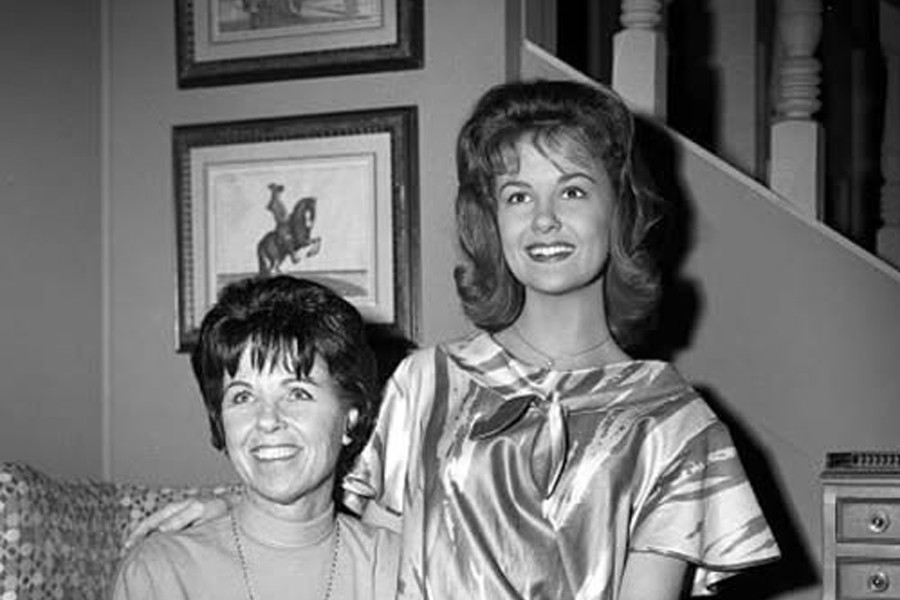
Elsa had two daughters, and both are essential to understanding her legacy.
Nanette Fabares, also known as Smokey, was the older daughter. She was born in 1941 and became an actress. Her career included work in television, and she is remembered as part of the same family circle that produced Shelley. Nanette may not have reached the same level of fame as her younger sister, but she still stands as an important part of the family story. I think of her as the elder branch of the tree, steady and less public, yet just as real.
Shelley Fabares, born Michele Ann Marie Fabares in 1944, became the most famous member of the family. She rose to prominence through The Donna Reed Show, later scored a major music hit with “Johnny Angel”, and eventually reached another generation of viewers through Coach. Shelley’s success made the Fabares name familiar to millions, but that success also reflects the home she came from. Elsa was there at the beginning, at the roots, before the lights, before the interviews, before the applause.
Shelley later spoke openly about her mother’s illness and death, which gives Elsa’s story an added emotional weight. Elsa was not just the mother of a star. She was the person whose life and decline helped shape Shelley’s later advocacy around Alzheimer’s disease. That kind of influence is quiet, but it can be seismic.
A family table in plain terms
| Family member | Relationship to Elsa | What is known |
|---|---|---|
| Samuel Hamilton Eyler | Father | Born in Pittsburgh in 1885, connected to shipping work |
| Ethel May Rumsey | Mother | Born in 1888, family line tied to the Rumsey branch |
| James Alan Fabares | Husband | Married Elsa in 1931, associated with real estate |
| Nanette Fabares | Daughter | Born in 1941, actress, older daughter |
| Shelley Fabares | Daughter | Born in 1944, actress and singer, younger daughter |
This family map may look simple, but it tells a rich story. Each person is a doorway into a different part of Elsa’s life. Her parents explain where she came from. Her husband explains the household she built. Her daughters explain the legacy she left behind.
Illness, memory, and the last chapter
Serious sickness impacted Elsa’s latter years. Later testimony linked Shelley’s mother’s multiple infarction dementia to Alzheimer’s disease. In September 1992, Elsa died. That loss was more than fatal. It shifted Shelley’s emotional center and inspired her to advocate for Alzheimer’s.
This aspect of Elsa’s history is touching because it shows how private anguish can affect others. The demise of one becomes another’s mission. One family’s suffering goes public. Due to her daughter’s disclosure, Elsa’s illness became public history. Though terrible, that is an inheritance.
Holy Cross Cemetery in Culver City was where Elsa was buried. Even in death, she is related to Southern California, where her family’s most notable events occurred. The successes of her children immortalized her life from Manila to Los Angeles, from private girl to wife and mother.
Why Elsa Fabares still matters
Elsa Fabares matters because family history is often the shadow behind public fame. Her life shows that not every important person stands under a spotlight. Some stand behind it, steadying the structure so that someone else can shine. She was a daughter, wife, and mother. She was part of a transpacific birth story, a Los Angeles marriage, and a family that entered American entertainment history through her children.
I see her as a human hinge in the family line. Before her were Samuel and Ethel. Beside her was James. After her came Nanette and Shelley. Through that sequence, a private woman became the center of a public family narrative. That is not a small thing. It is the kind of story that grows slowly, like roots under stone, invisible until the whole shape of the tree makes sense.
FAQ
Who was Elsa Fabares?
Elsa Fabares was Elsa Rose Eyler Fabares, born in 1911 in Manila, the mother of actresses Nanette Fabares and Shelley Fabares.
Who were Elsa Fabares’s parents?
Her parents were Samuel Hamilton Eyler and Ethel May Rumsey.
Was Elsa Fabares married?
Yes. She married James Alan Fabares in Los Angeles on March 8, 1931.
How many children did Elsa Fabares have?
She had two daughters, Nanette Fabares and Shelley Fabares.
What is Elsa Fabares known for today?
She is known mainly as the mother of Shelley Fabares and as part of the family background that supported a notable Hollywood career and later Alzheimer’s advocacy.