A life carved from granite and grit
Angelo Peter Buzzi worked with more than stone. He listened. He turned it into memorials, civic symbols, and lasting landmarks, leaving a career that feels more like a carved line in Northeastern public memory than a business record.
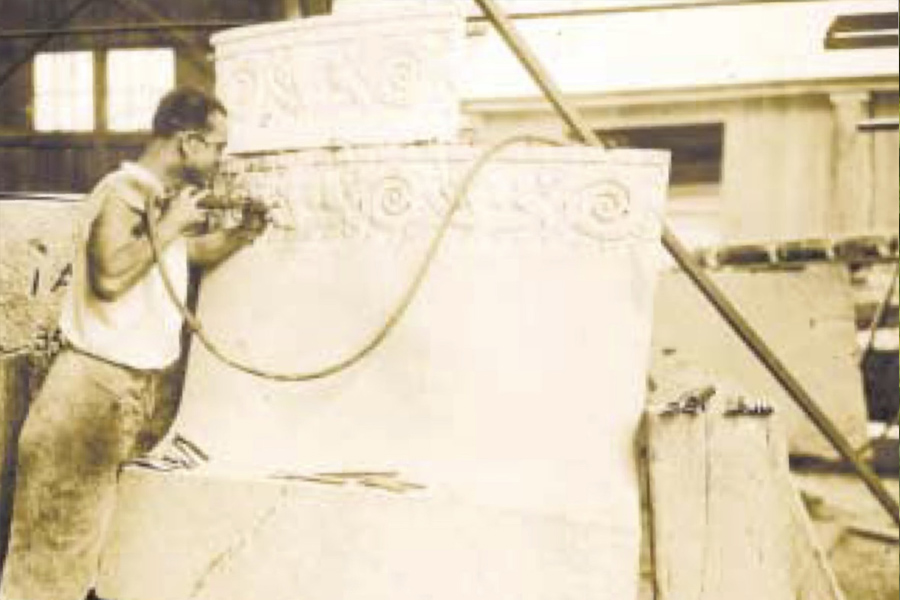
Family reports vary on his birth date at Arzo, Ticino, Switzerland, in 1900. Story shape is apparent. At seven years old, he started stonecutting and learned the craft for life. He was trained by hammer, chisel, and tradition as a boy. He developed skill that cannot be hastened from that early start. It must be earned grain-by-grain.
He arrived in America around 1923. After settling in Westerly and Stonington in 1933, he created Buzzi Memorials, a family business. In stonework-heavy areas, he helped define the trade. His work went beyond cemetery markers. He created public memorials and architectural stone features in everyday settings.
The man behind Buzzi Memorials
Buzzi Memorials was more than a shop. It was a workshop of memory. Angelo founded it in 1933 on Route 1 in Stonington, and the company became a family anchor as well as a professional one. He worked with his son Harold and built the business around craftsmanship, durability, and dignity.
I find it striking that he preferred memorials for towns and cities over individual grave markers. That preference says something about how he saw his role. He was not only preserving names. He was shaping public remembrance. He placed stone into the civic bloodstream. A monument, in his hands, was not just an object. It was a fixed point in history.
His work reached an impressive range of places. Among the landmarks associated with him were the Library of Congress, the National Archives, Penn Station, Grand Central Terminal, the Museum of Natural History, the Federal Reserve Building in El Paso, and the Massachusetts War Memorial on Mount Greylock. He also had work tied to the Federal Courthouse and the John Erickson Memorial in Washington, D.C., the West Virginia Capitol, the Equitable Trust Building in New York City, and memorials in Providence and Boston.
That list is not just a list. It is a map of trust. Institutions do not hand out stonework assignments lightly. A sculptor earns those commissions through precision, reliability, and reputation. Angelo Peter Buzzi appears to have had all three.
Rena Pauline Macchi Buzzi and the household he built
Behind the public work stood a family life that gave shape to the private side of his story. Angelo married Rena Pauline Macchi Buzzi in 1929. She was born in Gloucester, Massachusetts, in 1909 and lived until 1988. She was the center of the home sphere, the quiet counterpart to the hard edges of granite and marble.
Together, Angelo and Rena had at least three children who appear consistently in public records and family notices: Harold, Edward, and Ruth. The family line is important here because Angelo’s legacy was not carried only through monuments. It was carried through people.
Rena’s role in the story matters even when it is less visibly documented. A family business is never just a storefront and tools. It is a household rhythm. It is meals, schedules, sacrifice, and the invisible labor that keeps a shop alive for decades. I see Rena as part of the foundation, the mortar between the stones.
Harold G. Buzzi and the business continuity
Harold Gene Buzzi, born in 1930, became one of the strongest links between Angelo’s generation and the next. He worked in the family business, studied business administration at Bryant College, and served in the Marine Corps during the Korean Conflict. That combination of discipline, education, and service made him a natural heir to the shop.
After Angelo died, Harold took over Buzzi Memorials and carried the company forward for many years. His life reads like an extension of his father’s, but in a different key. Angelo was the maker, the carver, the founder. Harold was the steward, the manager, the man who kept the family enterprise steady across changing times.
Harold’s obituary also gives a clearer picture of the family network. He was married to Sally, and he was father to daughters Suzanne and Cheryl. A granddaughter, Madison, is also named in the family line. These details matter because they show how Angelo’s legacy moved outward, generation by generation, from workshop to household, from tools to names.
Edward R. Buzzi and the quieter branch of the family
Edward R. Buzzi is the least publicly detailed of Angelo’s children, but he remains part of the family structure. He is named in records as Harold’s brother and Ruth’s brother, which makes him an important thread in the larger family weave.
I do not see Edward’s story as missing. I see it as less publicly exposed. Many families have one member who becomes widely visible and others whose lives remain nearer to the private shoreline. Edward belongs to that quieter side of the family record. Even without a long public biography, his place is still clear. He was part of the same lineage, shaped by the same household, and connected to the same enduring name.
Ruth Buzzi and a different kind of legacy
Ruth Ann Buzzi, born in 1936, was the family’s most famous member. She became a comedian and actress, but Angelo’s craftsmanship remained with her. Family and obituaries list her as Angelo and Rena’s daughter. That puts a sculptor’s family behind one of America’s most famous comedians.
That contrast is almost poetic. Stone, quiet, permanence—Angelo worked. Ruth practiced timing, emotion, and laughter. One-shaped granite. Another drew attention. Beiden knew how to leave marks.
In 1978, Ruth married Kent Perkins. She had a distinct public cadence than her father, but the family identity remained. The legacy of Angelo, especially in memorials to her father’s stone sculpting, continues.
A family story held together by craft
When I look at Angelo Peter Buzzi’s life, I see more than a biography. I see a working philosophy. He learned early, emigrated young, built a business, raised a family, and left behind objects designed to outlast him. That is a rare shape of life. Many people work hard. Fewer build things meant to stand for decades in public view.
His family story strengthens that picture. Rena kept the home base. Harold carried the business. Edward remained part of the family line. Ruth turned the family name into a separate kind of public recognition. Together, they show a lineage that stretched in several directions at once, like branches from the same rooted trunk.
The dates help frame the arc. Born in 1900. Emigrated around 1923. Married in 1929. Founded the business in 1933. Raised children through the 1930s and beyond. Died in the 1960s, after building a reputation that still echoes. The numbers are simple, but the life behind them is not. It has the texture of chisel marks, the patience of long labor, and the depth of something made to last.
FAQ
Who was Angelo Peter Buzzi?
Angelo Peter Buzzi was a Swiss-born stone sculptor and monument maker who founded Buzzi Memorials in the United States. He is best known for his craftsmanship, his family business, and his work on public memorials and landmarks.
Who were Angelo Peter Buzzi’s family members?
His wife was Rena Pauline Macchi Buzzi. His children included Harold G. Buzzi, Edward R. Buzzi, and Ruth Buzzi. Harold continued the family business, Edward remains less publicly documented, and Ruth became a well-known entertainer.
What was Angelo Peter Buzzi known for professionally?
He was known for stone carving, memorial design, and landmark work. His career included projects connected to major institutions and civic sites, which reflected a reputation built on precision and trust.
What was Buzzi Memorials?
Buzzi Memorials was the family business Angelo founded in 1933 in Stonington. It became the center of his professional life and later passed into the hands of Harold, keeping the family legacy active for decades.
Why is Angelo Peter Buzzi still remembered?
He is remembered because his work was durable, visible, and public. He helped shape memorials and landmarks that outlived their maker, and his family carried that legacy into later generations.